Which Software Engineering Roles AI Will Replace by 2030?
Is software engineering career safe? Discover which roles are most vulnerable to AI disruption & automation and what you can do about it.
There has been a lot of speculation about AI displacing software engineering roles, with CEOs of big tech and AI companies leading the bandwagon. It's mostly FOMO amongst leadership -- an urge to sell AI to please their investors and boards. I have been in this industry for 14+ years and have seen software and systems built from scratch, first hand. I can safely say that the hype and fear-mongering is far from the truth.
Software development is not just about coding. Coding was always the easy part. It involves planning, organizing, breaking down complex requirements and even sometimes processing vague requirements into tangible solutions. Designing pipelines that catalyse faster iteration and smoother, zero-downtime delivery. Communication is a key skill in software engineering that no LLM prompt can replicate. That said, there are a few areas where AI can already excel with minor or no supervision. Here is my take on which areas AI, in its current form, can replace or drastically lower the need for specific skillsets -- and which ones it can't touch.
We've seen plenty of discussions about AI's impact on the job market in generic terms, but in this article we'll focus exclusively on its impact on Software Engineering and the auxiliary roles around it.
This list and its conclusions are based on personal experience, speculation, and research of a single individual. Please do your own research before drawing any conclusions.
Web Developers
Number one on the list -- and it shouldn't surprise anyone -- are Web Developers. Large Language Models (LLMs) are heavily trained on web technologies because they're freely available all over the internet. A simple web crawler can scrape an unlimited number of websites and learn their structure. Add the abundance of tech articles, tutorials, and documentation written around these technologies, and you've got a training goldmine for LLMs.
Here's the irony -- new JS frameworks and libraries pop up every other Monday, which drives existing frameworks to create extremely detailed documentation to stay relevant. But alas, it backfired. Those beautifully documented libraries became the perfect training data for AI models. React's docs are so good that AI can now write React better than most junior devs.
The bar to entry in web development has always been pretty low -- HTML, CSS, JS, and a framework like React or Vue is enough to call yourself a web developer. But that only gets you so far, and the same goes for LLMs.
Sure, LLMs can spit out an entire website from a zero-shot prompt and produce a flashy purple gradient landing page (no idea why AI loves gradients so much 😂) but they can never truly understand the thought that goes into why a website was designed a certain way. Which brings us to the skill every Web Dev should master: UI/UX Design. User eXperience is inherently human. You don't have to exhaust yourself learning every cool frontend framework on the market -- one is only marginally better than the other. In the era of AI, knowing React is probably enough, and it's probably going to be the last major JS framework to ever exist. AI defaults to React for any frontend code anyway.
Backend Developers
Behind every flashy UI, there is a backend where all the real magic happens. AI can generate backend code just as well as frontend code -- arguably even better. There's less wiggle room in backend development: given a good enough prompt with clear requirements, LLMs can generate Services and APIs in zero-shot. Backends are generally written in statically typed languages like Java, C++, or TypeScript (hate to include it as backend, but it checks all the boxes), which act as guardrails helping AI generate code with fewer runtime errors.
If your job as a backend developer is to just fetch data from sources (databases or APIs), stitch them together with some custom "business" logic, and return a response -- then my friend, AI can do your day's work in 2 minutes.
But of course, you know backend development is not just about fetching and stitching data. It's about scaling, resiliency, uptime, decoupling modules, lowering cloud bills. It's not about throwing a Kubernetes cluster with custom Docker pods and Terraforming the cloud just to serve 20 users on your company's internal tool -- or just because you heard a FAANG company does it. It's about knowing when to apply those uber solutions and when not to. Sometimes simpler, old-school solutions fare better than a perfect architecture that only looks good on paper.
This is what makes us different from AI. AI will churn out trendy architectures in no time, but you, as a seasoned backend developer, know the limits of each solution. You know the company's vision and where services actually need to scale. Which areas need an Event-Driven architecture and which would be perfectly fine with a simple Request-Response pattern. It's ultimately your call.
Manual Testers
Bruh! It's 2026 already bruh. Learn to automate. Use AI to write your automation scripts. <EOM/>
Ok fine, jokes aside -- if you're still doing only manual testing in 2026, the writing has been on the wall for a while. The industry has shifted towards QA Engineers and SDETs (Software Development Engineers in Test) who write automation frameworks, not just test cases. AI makes this transition easier than ever -- you can literally prompt it to generate Selenium, Playwright, or Cypress scripts from your manual test plans. The role isn't dying, it's evolving. Adapt or... well, you read the first line.
Scrum Masters
Are you a dedicated Scrum Master who doesn't code at all? Who just translates business requirements into JIRA/ADO tickets or handles the paperwork for a release? Or who simply chairs daily standups, transcribes the MOMs, and shoots updates up to management? Then sorry to break it to you, but those tasks can be automated -- squeezed into a couple of button clicks. To add to the burn, AI adoption will lead to smaller teams of high-calibre seasoned developers, which reduces the need for someone to continuously orchestrate their priorities. No developer likes being micro-managed.
But here's the thing -- worry not. You already have the skillset that AI cannot replace. Sure, AI can automate a few of the tasks you do daily, but you'll be the one who supervises the AI and clicks the button. This is actually an opportunity to expand into Product Management roles, overseeing different streams delivered by multiple teams at once. Leverage the free time to use AI to your advantage -- generate interactive dashboards to visualise metrics and reports for higher management. Your interpersonal skills are invaluable in the era of AI, something that no model can replicate in any true sense.
Least Impacted
Now let's talk about the roles that'll sleep peacefully at night.
UI/UX Designers
It was never just about pixels and getting stuff done with fewer clicks. That's a tiny fraction of what UI/UX Design is actually about. The real work is in user research -- interviewing real humans, understanding their frustrations, mapping their journeys, and designing experiences that feel intuitive without a tutorial. It's in running A/B tests and interpreting why variant B converted 12% better, not just that it did. It's in accessibility -- making sure your product works for the colour-blind user, the keyboard-only navigator, the screen reader.
AI can generate polished wireframes and prototype layouts, but it cannot sit in a room with your users and feel the friction they experience. Empathy is not a trainable parameter. Every user group has a unique workflow, and you are the bridge that translates their human needs into digital solutions.
FullStack Engineers
Every software engineer in the near future will have to be a FullStack Engineer -- or at least think like one. The kind of developer who knows the depth and breadth of the entire system. Who understands how the UI should be designed, coded, and optimised for performance. Who knows how the backend should be architected to scale gracefully under load. Who can look at the CI/CD pipeline and spot the bottleneck.
AI makes it easier than ever to be full-stack because it lowers the learning curve for unfamiliar domains. But the engineer who connects the dots across the stack and makes architectural decisions? That's not going anywhere. If anything, AI will amplify full-stack engineers by handling the boilerplate while they focus on the system design.
DevOps and Infra
With everyone churning out code like it's the end of the world -- even the CEO -- someone has to look after the pipelines, certificates, VPNs, server boxes, and the cloud bill that keeps climbing. That someone is you.
VMs working overtime because everyone wants to deploy their unoptimised, power-hungry, AI-coded "Slopware". Fans die, services need to be rebooted, SSL certs expire at 2 AM on a Saturday. Incident response, security patching, disaster recovery -- these are not glamorous, but they're the backbone of every production system. AI can write a Dockerfile, sure. But can it debug why your pods keep getting OOMKilled in a multi-tenant cluster at 3 AM? Can it decide whether your startup needs Kubernetes or if a simple PM2 process manager on a single VM would do just fine? Robust pipeline and release management will only become more essential as the volume of AI-generated code explodes.
Cyber Security Engineers
The more AI-generated code floods the codebase, the more Cyber Security Engineers become indispensable. AI has a hard ceiling -- the context window. Push past it and the model hallucinates logic and misses the bigger picture. Security flaws? Almost guaranteed.
LLMs are always playing catch-up. Their knowledge has a cutoff date, so the freshest attack vectors are already in the wild before the model has heard of them. You can patch this with RAG from OWASP or CVE databases, but RAG only prevents the same mistake from happening twice. It won't stop a brand new combination of attacks it has never seen.
A good CyberSec engineer thinks like an attacker -- probing angles that aren't immediately visible. Here's a telling example: humans can effortlessly visualise the back face of a 3D object. AI, given the same task, fails spectacularly. That "what isn't shown" thinking is exactly how security engineers hunt vulnerabilities. With AI expanding the attack surface daily, Cyber Security Engineers won't just keep up with bad actors -- they'll always be one step ahead.
Conclusions -- A Paradox
AI has lowered the bar for programming and building software. But as software engineers, we can raise the ceiling.
Here's the paradox -- and it has a name: Jevons Paradox. In 1865, economist William Jevons observed that when steam engines became more fuel-efficient, coal consumption didn't decrease -- it increased, because efficiency made steam power economically viable for far more applications. The same principle applies to software. When AI makes coding faster and cheaper, we don't need fewer engineers -- we need more, because suddenly every business, every team, every department wants custom software. The demand surges.
But here's the critical nuance -- more code being generated means more code that needs to be reviewed, tested, maintained, and debugged by actual software engineers who've seen systems run and fail in production. Without that human oversight, we'll drown in AI-generated "Slopware" -- bloated, unoptimised code built on patterns from 2024-25, stitched together by prompts that don't understand your system's context.
The engineers who thrive won't be the ones who write the most code. They'll be the ones who ask the right questions, make the right trade-offs, and know when to say "this doesn't need AI."
I'd love to hear your take on this -- do you agree with my list? Did I miss a role that's more at risk than I think? Or one that's safer? Drop your thoughts in the comments below, let's get a healthy debate going. 👇
Key Takeaways 🛍️
AI is here to stay as long as corporations are willing to burn fuel to keep it running. So focus on what matters:
- Critical thinking -- question everything, including AI's output
- Impact over features -- build what moves the needle, not what looks impressive in a demo
- Interpersonal skills -- collaboration, communication, and influence, both online and on-site
- Learning how to learn -- hard technical skills can be picked up; the key is learning fast and efficiently
- Follow your passion -- not your friends' or neighbours' career paths
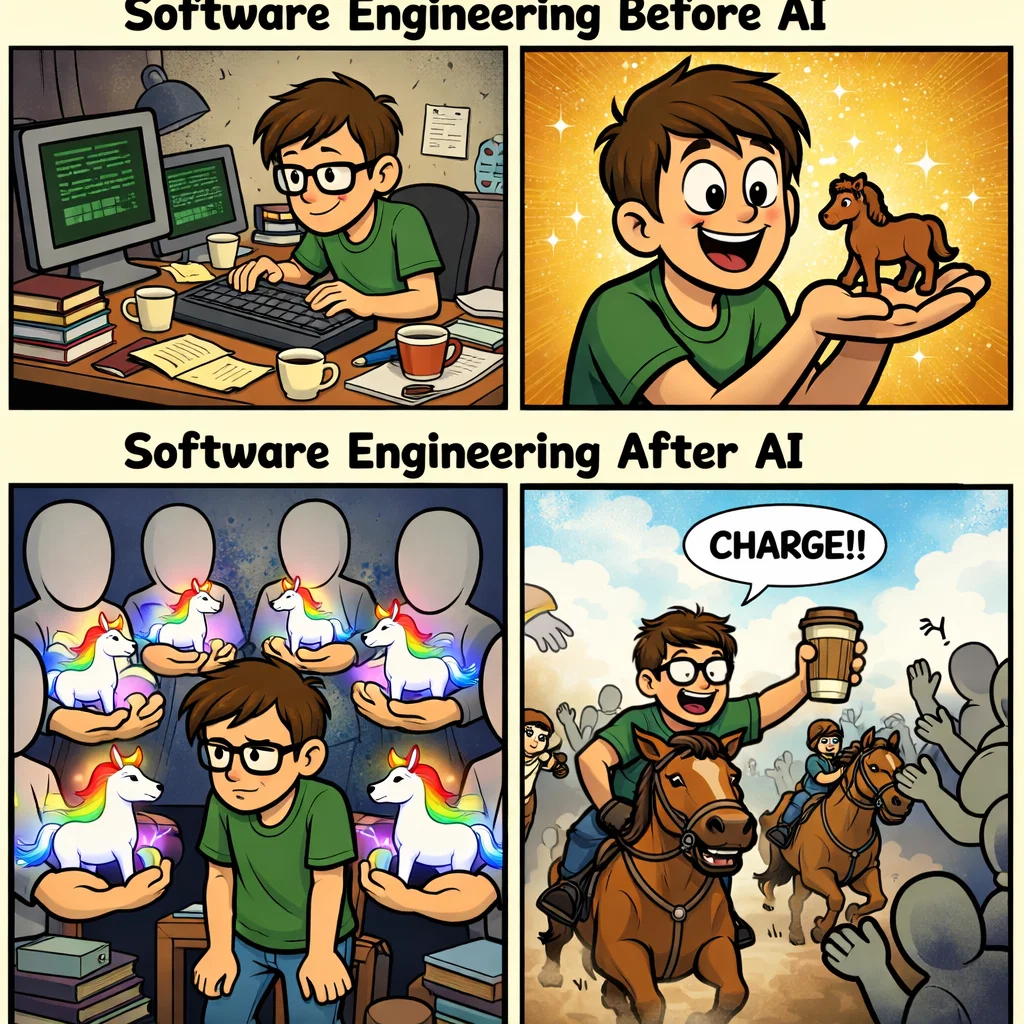
Here is a comic strip that I created using Sora to keep you motivated in the era of AI. It's a lighthearted take on the topic, but it captures the essence of how we can coexist with AI to empower ourselves.